Essays · Mental Models
Navigating Tough Times – The Gaussian Resilience Curve
Life rarely stays at the extremes. A mental model for absorbing difficult clusters, enjoying the upside, and building the capacity to bend instead of snap.
November 2, 2025 · 4 min read
The moment you start optimizing your life like a spreadsheet, you lose the rhythm that makes real resilience possible. The world doesn’t operate in straight lines; it behaves like a bell curve.
Life rarely stays at the extremes. The Gaussian Resilience Curve is a way to visualize emotional resilience: most days feel ordinary, while the edges hold both calamity and windfall. The point is not to predict what happens next. It is to prepare for variability without letting either extreme define your whole life.
A Story: When Everything Went Wrong at Once
Two projects crashed within a week, a key hire left, and a supplier delayed a shipment by a month. This isn’t a unique catastrophe—it’s a predictable cluster on the fattier end of reality’s curve. The question isn’t whether we can avoid it, but how we absorb it without breaking.
“Resilience is not the avoidance of pain; it is the mastery of response.”
The Mental Model Behind It
Imagine outcomes distributed along a Gaussian curve. Most days sit near the mean; the edges hold both calamity and windfall. Training isn’t about chasing the tail—it’s about widening your capacity around the center so you bend instead of snap.
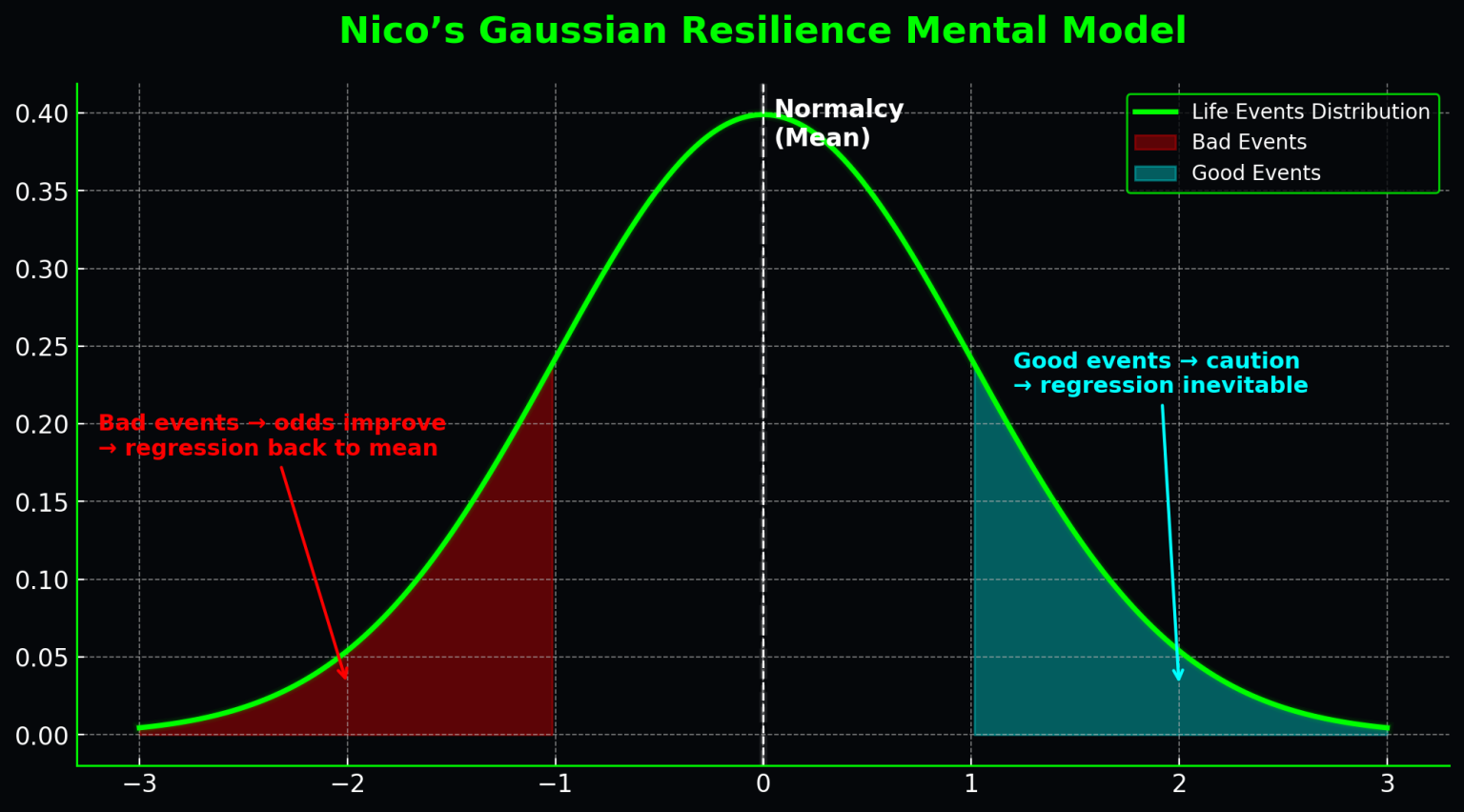
The curve is a simplified mental model. The shaded tails represent unusually difficult and unusually good experiences; the center represents normality.
When things go badly
A difficult cluster can make the current moment feel permanent. Looking at the wider curve is a reminder to leave room for ordinary days again. Rather than treating a setback as a new identity, focus on the buffers and choices that help you absorb it.
When things go well
The same perspective applies to a run of good luck. Enjoy it, but be careful about building permanent commitments on exceptional results. Preserve some of the upside as room to maneuver when conditions change.
Regression to the mean is useful context, not a promise: life events do not necessarily follow a normal distribution, and a bad event does not make a good event “due.” The model is about how we respond to extremes, not a statistical guarantee that the next outcome will balance the last one.
How to Practice It
Practice controlled exposure to variability: small bets, reversible choices, and regular “stress rehearsals.” Convert rare shocks into familiar drills.
- Expect clusters; design buffers. Leave some slack in your calendar, resources, and commitments so that one disruption does not immediately become several.
- Measure energy, not just time. A free hour on the calendar is not always an hour of usable capacity. Plan around what you can actually bring to the work.
- Stack reversible decisions; buy options on upside. Start with choices you can adjust. Keep room to change direction as you learn.
The aim is not to eliminate uncertainty. It is to widen the range of circumstances you can meet without losing your footing.
Adapted from the original essay, published November 2, 2025, expanded with the author-supplied Gaussian Resilience Mental Model graphic.